
Trading Session Overview
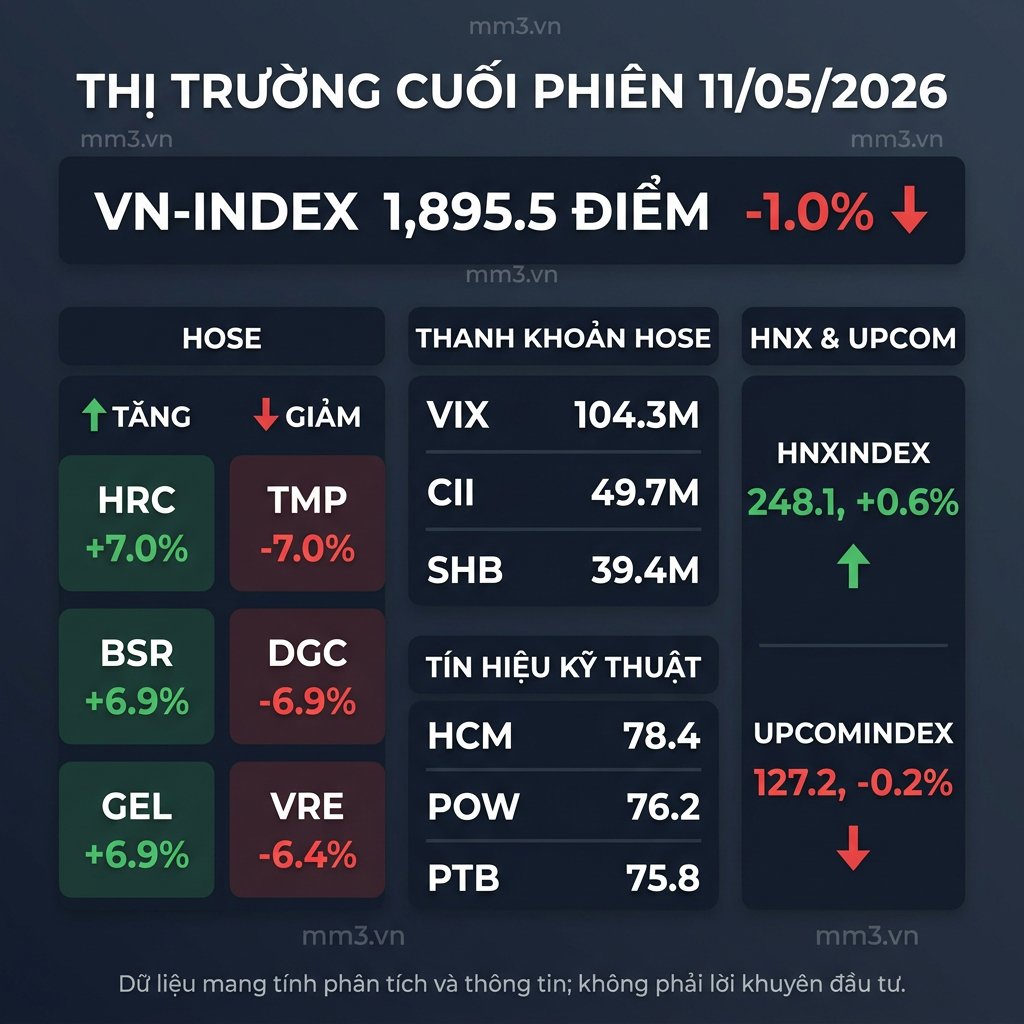
The market closed the 11/05 session with clearly divergent performance across the three exchanges. The VN-Index closed at 1,895.5 points, down 1.0%, while overall market liquidity remained high, with total matched volume of nearly 960.7 million shares on HOSE. Breadth tilted toward a corrective stance as large-cap groups came under pressure, although a number of individual stocks still maintained positive technical structures.
In terms of index movement, the HNX-Index rose 0.6% to 248.1 points, while the UPCOM-Index edged down 0.2% to 127.2 points. This divergence suggests that money flow tended to rotate into mid-cap and small-cap stocks, while profit-taking pressure continued to weigh on the leading stocks on HOSE.
Notable Stock Groups
On HOSE, the strongest gainers of the session were HRC (+7.0%), BSR (+6.9%) and GEL (+6.9%). These were rare bright spots against a backdrop in which the broader exchange was dominated by corrective pressure across many pillar industry groups.
On the other side, TMP (-7.0%), DGC (-6.9%) and VRE (-6.4%) were among the steepest decliners. This movement reflects the high volatility in stocks attracting money-flow attention but lacking consensus support from the broader market.
Liquidity and Market Breadth
Liquidity was the most notable feature of the session, as many stocks traded actively. Leading HOSE in matched volume was VIX with 104.3 million shares, followed by CII with 49.7 million shares and SHB with 39.4 million shares.
The large trading volumes in these stocks indicate that money flow remains present, but it is highly dispersed across individual stories rather than spreading evenly across the market. Breadth therefore leaned toward a selective stance, with only a handful of stocks sustaining a clear upward trend.
Sector Analysis
From a sector perspective, the financial and construction materials groups continued to be the focal points of liquidity, although price movements were uneven. Notably, VIX rose 4.0% with a trading value of over 2,018.0 billion VND, while CII gained 6.8% and BSR gained 6.9%, showing that investors were still willing to chase certain stocks with their own compelling stories.
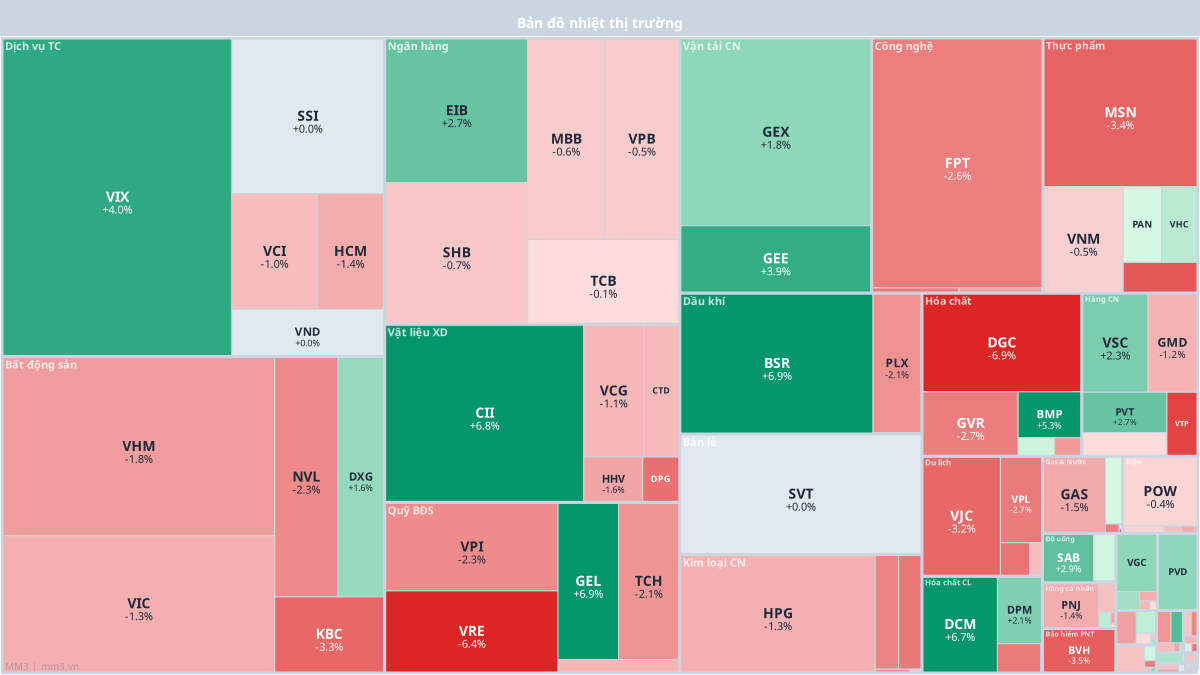
Conversely, many stocks in the technology, chemicals, retail and real estate groups faced clear pressure. FPT fell 2.6%, DGC fell 6.9% and VRE fell 6.4%, showing that the divergence is creating wide gaps between industry groups within the same session.
| Sector/Industry | Notable Developments | Observations |
|---|---|---|
| Financial Services | VIX, SSI, VCI, HCM, VND | Cash flow is concentrated strongly, but divergence is high |
| Real Estate | VHM, VIC, NVL, DXG, KBC, VRE | Many stocks are under correction pressure |
| Chemicals | DGC, GVR, BMP, DPR, PHR | Volatility is strong, with wide price ranges |
| Oil and Gas | BSR, PLX, TDG | Some individual bright spots have emerged |
Notable Technical Signals
Among the positive technical signals, HCM achieved a composite score of 78.4 with an RSI of 59, while both MACD and EMA are in positive territory. Next is POW with 76.2 points, followed by PTB with 75.8 points, indicating that some stocks still maintain a price base and trend structure that is more stable than the overall market.
These signals reflect that technical rebound potential still exists in individual stocks, especially as capital has not fully exited but is rotating into a sideways phase. However, the decline of the broader index amid highly divergent breadth suggests that short-term volatility risk remains significant.
Outlook for the Next Session
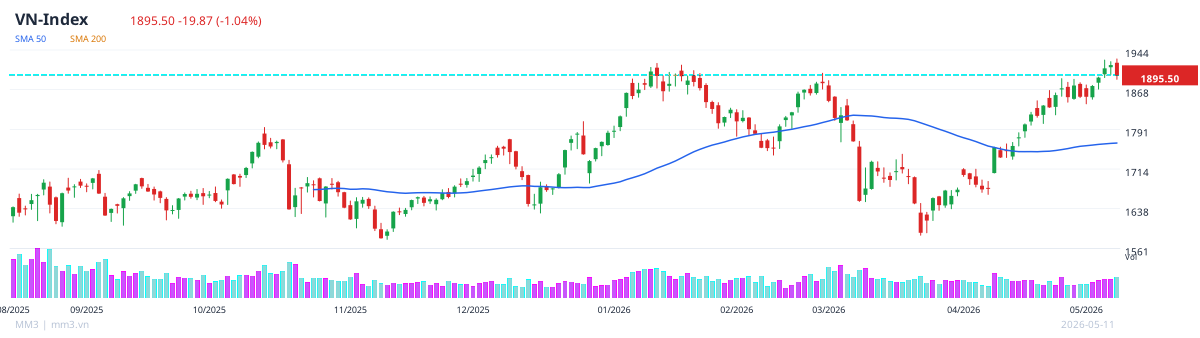
Technically, the VN-Index is approaching short-term resistance around 1,900 points, while nearby support is being watched around 1,880-1,885 points. If buying demand is not strong enough to absorb profit-taking pressure at higher levels, choppy, sideways trading may continue in the coming sessions.
Investors should pay attention to the reaction of large-cap stocks, especially liquidity-leading names such as VIX, CII, SHB, as well as stocks showing good technical signals such as HCM, POW, and PTB. In addition, international developments and domestic capital flows will continue to be the two key factors determining market conditions in the short term.
For analytical and informational reference only; this is not investment advice.